
Mascarpone vs Cream Cheese? A comparison that arises in every culinary creation. So, what’s the actual difference? Both the cheese varieties have a similar creamy texture, but their flavour, fat content and stability during cooking vary significantly. This reflects in the outcome in the dishes such as Tiramisu, Cheesecake, frostings and savoury dips.
- What is Mascarpone?
- What is Cream Cheese?
- Key Differences: Mascarpone vs Cream Cheese
- Nutritional difference between Mascarpone and Cream Cheese
- Price, Storage, and Availability in India
- Mascarpone vs Cream Cheese: How and where to use?
- Dishes that use Mascarpone vs Cream Cheese
- To conclude
- Frequently asked questions

What is Mascarpone?
Mascarpone is a rich, buttery and sweet Italian cheese that is made from cream coagulated with citric or tartaric acid, which causes the cream to separate and thicken.
It originated in the Lombardy region of Northern Italy in the late 16th century. It is used in various Italian desserts like Tiramisu, no-bake cheesecake, savoury sauces and dips.
It is a super creamy, rich, and smooth with a velvety buttery feel. It has a slightly sweet, buttery flavour, which makes it ideal for desserts.
What is Cream Cheese?
On the other hand, Cream Cheese is made from milk and cream, cultured with lactic acid bacteria for the tangy flavour. It is slightly denser than Mascarpone and a little less sweet.
It originated in the United States in the early 1870s, mass-produced by William A. Lawrence, a dairyman from Chester, New York. He first began making a Neufchâtel-style cheese, but later added the cream to develop a super-rich and creamy cheese.
Cream cheese is a denser, firm, but spreadable cheese. It is tangier, sour and has a sharp taste, making it suitable for sweet and savoury dishes.
Defining them is easy. But, what is the actual difference between Mascarpone and Cream Cheese? Where are they used, and how does their use impact the product output? Let’s explore.
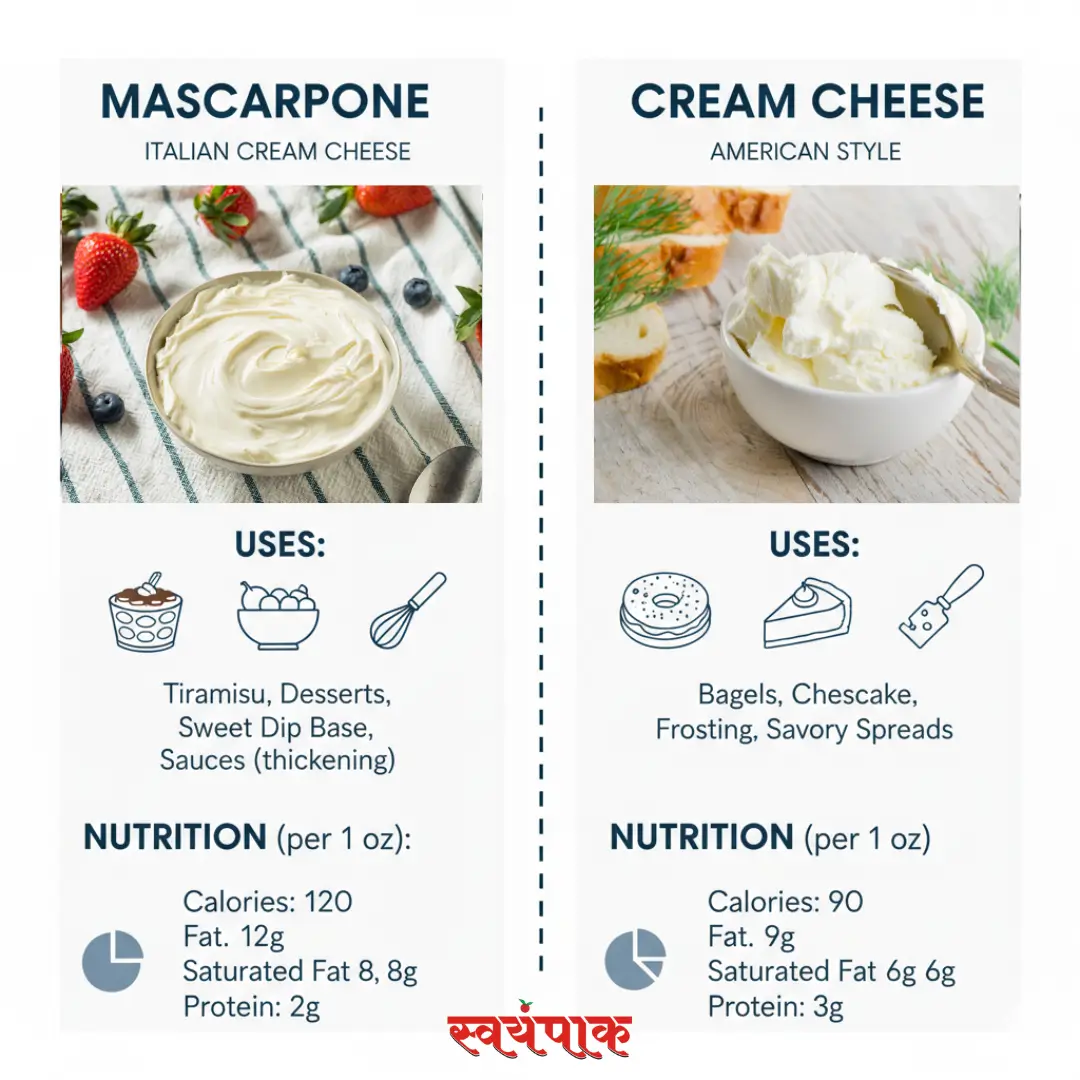
Key Differences: Mascarpone vs Cream Cheese
| Feature | Mascarpone | Cream Cheese |
|---|---|---|
| Origin | Italy (Lombardy region) | United States |
| Main Ingredients | Heavy cream coagulated with citric/tartaric acid | Milk and cream cultured with lactic acid bacteria |
| Fat Content | Very high, around 60-75% | Moderate, around 30-40% |
| Texture | Very soft, smooth, velvety, spreadable | Firmer, creamier, but denser and less soft |
| Flavor | Mildly sweet, rich, buttery | Tangy, slightly sour, mild |
| Appearance | White, creamy | White, creamy |
| Culinary Uses | Italian desserts (tiramisu), creamy sauces, rich spreads | Cheesecakes, frostings, dips, savoury spreads, baking |
| Taste Profile | Subtle sweetness with creamy richness | Mild tanginess with creamy texture |
| Cooking Stability | Delicate, melts easily | More stable, holds shape better |
| Price & Availability | Generally more expensive, less widely available | More affordable, widely available |
| Suitable for | Rich desserts, creamy toppings, and sauces | Versatile in sweet and savoury dishes |
Nutritional difference between Mascarpone and Cream Cheese
Mascarpone and Cream Cheese are both soft and spreadable cheeses with a slight culinary difference in ingredients used, flavour profile, fat content and the actual uses. The following table shows a nutritional comparison of 100 grams of Mascarpone and Cream Cheese.
| Nutrient | Mascarpone | Cream Cheese |
|---|---|---|
| Calories | ~429 kcal | ~350-370 kcal |
| Total Fat | 42-45 g | 33-35 g |
| Saturated Fat | High (about 30 g) | Lower than mascarpone |
| Protein | 4-6 g | 6-7 g |
| Carbohydrates | 3-4 g | 4-5 g |
| Sugar | 3-4 g | 2-3 g |
| Sodium | ~40 mg | Higher (~300 mg) |
Culinary Uses: Mascarpone
- Mascarpone is an essential element in Italian desserts like Tiramisu to give it a rich and creamy texture.
- It is used to make fruit tarts, no-bake cheesecakes, and whipped into frostings to make them silky.
- To make the pasta sauce rich without disturbing the flavour.
- It is added to savoury dishes like Polenta, Risotto, and soups to add a super smoothness.
Culinary Uses: Cream Cheese
- It is a must-have element in cheesecakes, frostings to provide a tangy depth.
- It is used as a spread on toasts, wraps, bagels, crackers, etc.
- It is added to salad dressings and dips.
- Baked goods like muffins, pancakes need cream cheese to enhance the flavour and moisture.
Substitution: Can You Swap Them?
Mascarpone and Cream cheese can be substituted for each other SOMETIMES. Mascarpone has a delicate texture and high fat content. To achieve this similarity, cream cheese may need an addition of cream to lighten it.
On the other hand, Mascarpone cannot easily achieve the tangy flavour and firmness of the cream cheese.
Price, Storage, and Availability in India
As per their properties and ingredients, Mascarpone and Cream Cheese are available in India for every culinary artist.
Price
- Mascarpone is generally costlier due to its higher fat content, artisanal production and import costs.
- Cream cheese is comparatively affordable and easily available in domestic and international brands.
Storage
- Mascarpone has a shorter shelf life and must be used up within 5-7 days.
- Cream cheese has a slightly longer shelf life of 10-14 days because of preservatives and stabilisers.
- But both of them need to be stored between 2-4 °C.
Availability
- Mascarpone is less common and available in premium groceries and speciality cheese shops.
- Cream cheese is widely and easily available in supermarkets and online marketplaces.
Mascarpone vs Cream Cheese: How and where to use?
Both Mascarpone and Cream Cheese have different uses and culinary applications. You need to understand their unique qualities to ensure the correct usage and get the best results in the final recipe.
How and where to use Mascarpone?
- It is used in desserts like Tiramisu, cheesecakes, and fruit tarts for that extra silkiness.
- It is ideal for rich, creamy dishes that require a smooth texture.
- It helps boost the creaminess in Pasta sauces, Risottos or soups.
- Adding sugar to Mascarpone can help in creating luxurious dessert toppings.
- It can be blended with herbs and spices to make savoury dressings.
How and where to use Cream Cheese?
- Cream cheese is used to spread on bagels, toasts, crackers and sandwiches.
- It can be blended into savoury dishes like meats, casseroles, and sauces that require a tangy flavour.
- It can withstand moderate heat while cooking and baking.
- It is incorporated into muffins, baked goods, savoury bread and pancakes.
Dishes that use Mascarpone vs Cream Cheese
| Dishes Using Mascarpone | Dishes Using Cream Cheese |
|---|---|
| Tiramisu (classic Italian dessert) | New York-style Cheesecake |
| No-bake cheesecakes | Frostings (cream cheese frosting on cakes) |
| Mascarpone mousse | Spinach and artichoke dip |
| Mascarpone pasta sauce (creamy pasta) | Bagels with cream cheese spread |
| Fruit tarts with mascarpone cream | Cream cheese stuffed chicken breasts |
| Mascarpone panna cotta | Buffalo chicken dip |
| Risotto with mascarpone for creaminess | Cream cheese cupcakes |
| Mascarpone and berries dessert parfait | Cream cheese danishes (pastries) |
| Savoury mascarpone spreads with herbs | Cheesecake bars and bites |
| Mascarpone-topped soups (like tomato bisque) | Savoury dips and spreads blended with herbs/salsa |
To conclude
Mascarpone vs Cream cheese. A comparison thta will alway be alive in the culinary world. To give you a pinpoint conclusion, both cheese have a versatile qualities that elevate any culinary creation. Mascarpone is perfect for smooth and creamy desserts, whereas cream cheese is ideal as a kitchen staple.
Knowking the differnce helps you select the right cheese for the right dish. Both of them have the qualities to bring something special to your table.
Frequently asked questions
Can I replace mascarpone with cream cheese?
Yes, you can replace Mascarpone with Cream Cheese by using full-fat cream in a 1:1 ratio. To achieve a similar flavour, soften the cream cheese by adding a bit of heavy cream in a 3:1 ratio. Add a little powdered sugar or vanilla to mimic the sweeter profile. This combination works well in Tiramisu and no-bake cheesecakes.
Is it better to use mascarpone or cream cheese?
Both of them are individually suitable for a particual set of dishes. the choice depends on what you want as a flavour and for what dish.
What is the difference between mascarpone and cream cheese in tiramisu?
For Tiramisu, Mascarpone is the ideal choice due to its rich, smooth and mild buttery flavour. Cream chesse blended with heavy cream can be used, but it will affect the flavour profile and consistency.
What is so special about mascarpone cheese?
Its’ creation and texture makes it a super unique type of cream wich servces as a key ingredient in various dishes and desserts. It’s high fat content gives it a ore indulgent flavour. Mascarpone is delicat ena dvery much suitable for desserts, pastas risottos and even soups.