
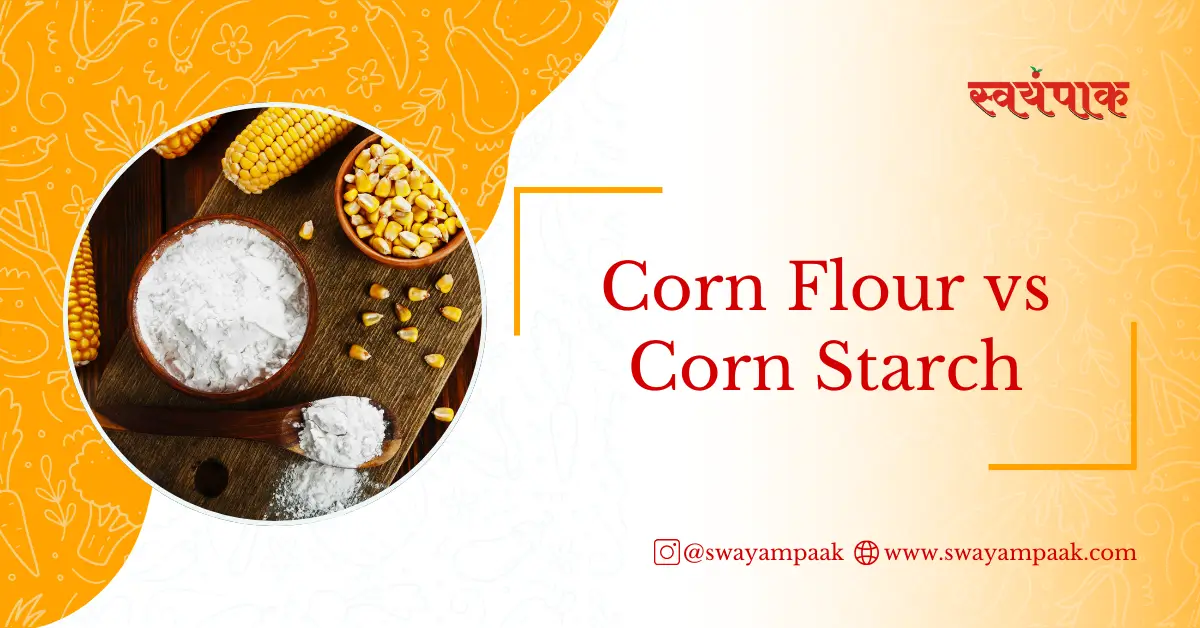
To put it simply, Corn flour is made from whole corn kernels, and it adds flavour and body to a component. Whereas corn starch is refined and used as a neutral thickener in sauces and frying.
So, in every kitchen, there is always confusion about which one to use and when: Corn Flour vs Corn Starch. What are thier use and how are they different?
Recognising the difference between corn flour and corn starch goes beyond using the right ingredient in a culinary disaster, and it goes beyond simply knowing which ingredient will give you what you want based on texture, taste, and desired outcome.
Whether it is thickening a sauce, as a crunchy coating for your dish, or even a gluten-free homemade bread, selecting the right ingredient between corn flour and corn starch can be the difference between a culinary triumph and a culinary disaster.
- What is Corn Flour?
- What is Corn Starch?
- Corn Flour vs Corn Starch [The Difference]
- Nutritional Comparison
- Corn Flour vs Corn Starch in Indian Recipes
- Kitchen Uses
- The Science of Thickening
- Regional Variations: A Critical Note
- Real-World Confusion Examples
- Can I Substitute Corn Flour Instead of Corn Starch?
- Corn Flour vs Corn Starch: Are They the Same?
- Corn Flour vs Corn Starch
- Substitutions and Tips
- Common Mistakes to Avoid
- Storage and Shelf Life
- Conclusion
What is Corn Flour?
Corn flour is prepared by grinding the entire corn kernel into a fine powder. The entire corn kernel, which includes the hull, germ, and endosperm, is processed. Hence, corn flour preserves the entire natural goodness found in corn. Corn flour also retains the nutritional properties of the whole grain because it is not refined like corn starch.
Key Characteristics:
- Yellow colour (with a white variant)
- Distinct, sweet corn flavour
- Rich in protein, fibre, and vitamins
- Coarser than corn starch
- Higher fat content due to the germ
Common Uses:
- Corn breads, muffins
- Tortillas and falafels
- Coating for fried foods (adds flavour and colour)
- Gluten-free baking blends
- Thickening agent where corn flavour is required
- Polenta and porridge
Because the entire kernel is present in corn flour, it has different usage properties from other starchy flours because it absorbs water slowly and helps to form the structure in cornbread and in the making of Mexican tortillas.
What is Corn Starch?
Corn starch, also known as cornflour in the UK, is the starch that is derived from corn, but only from the endosperm of the corn. The protein, fibres, and fat are removed to make it a refined white starch that contains almost 100% carbohydrates. The refinement of corn starch gives it all its special properties.
Key Characteristics:
- Snow-white colour
- Flavourless and odourless
- Ultra-fine, silky smooth texture
- High thickening power (twice that of wheat flour)
- It won’t affect the taste of other foods
Common Uses:
- Thickening sauces, gravies, and soups
- Making crispy coatings for Asian-style frying
- Custards, puddings, and pie fillings
- Prevention of icing sugar caking
- Setting agents in confectionery
- Gluten-free baking (for tenderness)
Corn starch’s superpower is its ability to absorb water when heated and turn viscous. Corn starch is a great addition when you need a thickening agent but do not require a change in the taste profile of your food product.
Corn Flour vs Corn Starch [The Difference]
| Aspect | Corn Flour | Corn Starch |
|---|---|---|
| Colour | Yellow | White |
| Flavour | Distinct corn flavour | Neutral or flavourless |
| Texture | Slightly grainy | Ultra-fine powder |
| Nutritional Value | Higher (fibre, protein) | Minimal |
| Thickening Power | Moderate | High |
| Best for Use In | Baking, bread-making, flavour | Thickeners, crispy coatings |
| Processing | Whole kernel ground | Starch extracted from endosperm |
| Gluten Content | None (naturally GF) | None (naturally GF) |
Nutritional Comparison
The difference in nutrition between corn flour and corn starch will allow you to make the right decisions regarding your diet.
Corn Flour (per 100g):
- Calories: 361
- Protein: 6g
- Fibre: 7g
- Fat: 3.9g
- Carbohydrates: High in carbs
- Rich in B vitamins, iron, and magnesium
Corn Starch (per 100g):
- Calories: 381
- Protein: 0g
- Fibre: 0g
- Fat: 0g
- Carbohydrates: High in carbs
- Traces of vitamins and minerals
The difference is quite clear here, and that’s due to the higher nutritional content found in corn flour compared to corn starch.
With regard to its uses, corn flour is better due to its higher fibre and protein content. Corn flour contains fibre, which helps with digestion, and protein content, which increases satiety. Corn starch is even less beneficial since it contains minimal fibre or protein.
For diabetics, both have high glycaemic index values, although corn flour’s fibre delays the absorption of sugar slightly. Both lack the necessary protein, although corn flour, to some extent, satisfies the fibre requirement.
Corn Flour vs Corn Starch in Indian Recipes
In various Indian recipes, corn flour and corn starch are often confused with each other. But their uses and purposes are totally different. Corn starch is flavourless and is used as a thickening agent.
Corn starch is widely used in:
- Veg Manchurian gravy
- Chicken Manchurian
- Hot and sour soup
- Sweet corn soup
- Chilli chicken
- Crispy vegetable coatings
- Indo-Chinese sauces
Corn Flour (Rarely Used)
Corn flour (yellow, whole-grain) is:
- Not traditionally used in Indian curries or gravies
- Occasionally used in fusion or experimental cooking
- More common in baking or Western dishes
Using corn flour instead of corn starch in Indian gravies can:
- Change the colour to yellow
- Add unwanted corn flavour
- Result in a grainy texture
Kitchen Uses
When to Use Corn Flour
Corn flour also excels in preparations where corn flavour and nutritional benefits are desired:
- Cornbread: This adds the necessary texture, corn flavour, and typical yellow colour of cornbread. The coarseness adds a texture that needs to be achieved for the corn flavour to shine.
- Batters: Enhances the taste of pakoras, fritters, and tempura alternatives. Corn flavour works well with vegetables.
- Gluten-free baking: Often used in combination with other flours (rice, tapioca) for breads and cakes.
- Breading: This can be blended with breadcrumbs to get a tasty coating for chicken or fish. The taste of corn gives it a special flair.
- Tortillas: A key component in making corn tortillas, where emphasis is on flavour.
Pro Tip: If you are mixing with corn flour, rest the mixture for 10–15 minutes before baking.
When to Use Corn Starch
Corn starch is great if you need to thicken or add texture, but are not required to change flavour:
- Stir-fry sauces: Produces a smooth, sticky sauce that clings to all pieces of vegetables or meat. Thicken by mixing with cold water first.
- Gravy: Enhances thickness without cloudiness and prevents the addition of a “floury” flavour. Great when you want the meat flavour to be at its best.
- Korean fried chicken: Creates a remarkably crispy coating resembling glass with a longer crisp retention than wheat flour.
- Fruit pie fillings: Thickens fruit juices without clouding or gelatinising them.
- Custards: Adds smoothness to custard without the danger of curdling.
Pro Tip: Corn starch thickens at 95°C. If it’s still too thin in your sauce, it could be that it hasn’t been heated enough. Don’t boil it vigorously, as this will break down the starch molecules.
What Happens When You Use the Wrong One?
The use of corn flour in place of corn starch as a thickener leads to:
- Less thickening strength (requires more)
- Yellow-tinged sauce
- Corn flavour where it shouldn’t be
- Slightly grainy texture
If corn starch is substituted for corn flour when baking, the result will be:
- Bland, flavourless results
- Lack of structure
- Excessively tender, almost gummy consistency
- Incorrect colour (pale instead of gold)
When to use them: If a recipe requires flavour and texture, corn flour should be used. If a recipe is to be thickened or made crisp without any flavour addition, corn starch should be used.
The Science of Thickening
Corn starch molecules form a tightly packed mass known as a granule that is non-reactive when exposed to cold fluids but swells when heated because it absorbs water molecules through a process referred to as gelatinisation.
Around 62–72°C, they start swelling and by 95°C, they will have absorbed the maximum amount of water and burst, with the resulting starch molecules becoming entangled, thus forming viscosity. That’s why corn starch mixtures instantly become thick at a given temperature.
Temperature matters:
- Too little heat → no thickening
- Best heat temp: 95°C → Best thickness
- Too much boiling → broken-down starches → thinning sauce
Corn starch makes crispy coatings because the starch particles remain on the surface of the food; as the food fries, the starch particles dehydrate, and a crisp structure is created. Corn starch does not contain gluten like wheat flour does. As a result, instead of a protein structure providing a chewy texture, it’s all crunchy.
Corn flour can be thickened too; however, it has only around 60–70% starch (compared to corn starch’s ~100%), so it needs to be used in larger amounts, and it won’t be clear or taste neutral.
Regional Variations: A Critical Note
It can easily become confusing to distinguish between corn flour and corn starch based on the naming conventions used in different regions. In the UK, Australia and New Zealand, the pure white starch product is called cornflour, which is equivalent to corn starch in the US. In the US, corn flour refers to finely ground whole corn kernels.
In the United States:
- “Corn starch” = The thickening agent made from corn.
- “Corn flour” = Ground whole corn.
- “Cornflour” (one word) = Not commonly used.
In Other Regions:
- Some nations employ the term “maize starch” alone.
- In Latin American countries, “harina de maíz” (corn flour) is differentiated from “fécula de maíz” (corn starch).
Real-World Confusion Examples
Picture a British recipe calling for “cornflour” as a thickener in gravy; Americans would add yellow corn flour and wonder what the strange taste of their gravy is all about. A British person following an American recipe for cornbread would reach for their “cornflour” stash, which contains starch, and produce a flavourless paste.
Brand Name Differences
Cornflour in the UK consists of Bisto cornflour or own-brand versions bearing the “cornflour” name. In the US, corn starch is manufactured by Argo and Clabber Girl. Even in similar locations, sharing the same continent, different brand names are used based on regional location.
Label-Reading Tips
- Labels are often more prominent than names.
- Always check the ingredients list.
- Corn starch should be a pure white colour.
- Ingredients should read:
- Corn starch: maize starch/corn
- Corn flour will be yellowish and may contain “whole grain maize” or “corn”.
- If the method is not clear, refer to the application:
- Thickening = starch
- When unsure, look at the location of the recipe’s author.
Can I Substitute Corn Flour Instead of Corn Starch?
Not always. The large difference between corn flour and corn starch prevents them from being used as direct substitutions.
For Thickening Sauces or Gravies:
Corn flour has semi-thickening capabilities compared to corn starch. You will need about 2 tablespoons of corn flour for every 1 tablespoon of corn starch required for the recipe. However, it is essential to note that:
- Your sauce will turn yellow in colour
- You will experience corn flavour
- The texture may have a slight grainy quality
- It is more useful in recipes where corn flavour is not undesirable (e.g. Southwestern stews)
For Crispy Coatings:
Corn flour can also be used, though it yields a slightly different end product:
- Less crispy, more flavoursome coating
- Golden skin instead of pale skin
- More suited to Southern-style fried chicken than Asian-style tempura
For Baking:
Replacing corn flour with corn starch in a recipe like cornbread will yield a flavourless, textureless dish lacking the characteristic flavour and colour of corn. Do not substitute corn starch for corn flour.
For Thickening Fruit Pies:
It is possible to use corn flour, but this will give a slight cloudiness to the filling and impart a corn flavour. For berry pies, this won’t matter much, but for peach pie, corn starch is the better choice.
Corn Flour vs Corn Starch: Are They the Same?
No.
Even though both ingredients originate from corn, the comparison between corn flour and corn starch shows that they are two vastly different commodities:
- Corn flour is a whole grain. The entire kernel is ground into flour.
- Corn starch is a refined starch, merely the pure starch extracted from the endosperm.
They differ in:
- Colour (yellow vs white)
- Flavour (corn taste vs neutral)
- Nutrition (whole grain vs pure carbohydrate)
- Culinary use (structure and flavour vs thickening and crispness)
- Processing type (grinding vs extraction)
It is not dissimilar to the distinction between wholemeal flour and white flour – the same source, but altogether different.
Corn Flour vs Corn Starch
Neither is necessarily a “better” substitute. It all depends on your recipe and what you’re trying to achieve.
Select Corn Starch When:
- Dishes or sauces where appearance is important
- Maximum thickening with a minimum amount
- Gluten-free thickening with no flavour
- Crispy fried coatings (mostly Asian cuisine)
- Custards and puddings require a smooth consistency
- You do not want to alter the flavour of the dish
Choose Corn Flour When:
- Incorporating the flavour and colour of corn
- Gluten-free baking (with other flours)
- Nutritional value (fibre and protein)
- Cornbread, tortillas, or polenta
- Breading where corn taste is desired
- Recipes where corn is already part of the ingredient list
Use Wheat Flour When:
- Making roux sauces (such as béchamel)
- General baking structure and gluten formation
- When a slightly opaque, rustic sauce is appropriate
- Making pasta sauces
- Low-cost thickening for general cooking
- Recipes that require the binding power of gluten
Corn Starch vs Wheat Flour as a Thickener
Corn starch has double the thickening ability and produces clearer sauces compared to wheat flour. Use 1 tablespoon of corn starch instead of 2 tablespoons of wheat flour. However, wheat flour can be cooked into a roux, whereas corn starch cannot.
Substitutions and Tips
If You’re Out of Corn Starch:
- Arrowroot powder: Use equal proportions. Ideal for acidic dishes and yields fluid sauces. Add towards the end, as it breaks down with prolonged heat.
- Tapioca starch: Use 2 teaspoons for every tablespoon of corn starch. Produces a shiny texture and is ideal for fruit pies. Freezes well.
- Potato starch: Use the same amount. Do not boil. Has excellent thickening power but loses effectiveness if overheated.
- Rice flour: Use double the amount. Produces cloudy results and may taste chalky. Common in Asian cooking.
- Wheat flour: Use double the amount. Requires longer cooking and produces opaque sauces.
If You’re Out of Corn Flour:
- Fine polenta: Use the same quantity. Similar texture, slightly coarser.
- Masa harina: Suitable only for tortillas. Processed with lime water, resulting in a different flavour but similar function.
- Gluten-free flour blends: Adjust depending on the blend.
- Cornmeal: Use only finely ground cornmeal. Coarse cornmeal is unsuitable for most baking.
Common Mistakes to Avoid
- Adding corn starch directly to hot liquids: Always mix with cold water first to avoid lumps.
- Overheating corn starch sauces: Boiling breaks down starch molecules, resulting in watery sauces.
- Using corn flour for delicate sauces: It imparts colour and flavour, but is unsuitable for white or vanilla sauces.
- Assuming UK and US terms are interchangeable: Always check packaging when using international recipes.
- Using volume instead of weight measurements: Corn starch is denser; weigh for accuracy.
- Ignoring acidity: Acidic ingredients can prevent proper thickening.
- Freezing corn starch-based sauces: They become spongy when thawed. Tapioca starch freezes better.
Storage and Shelf Life
Corn Starch:
- Store in an airtight container in a cool, dry place
- Shelf life: Indefinite if kept dry (best quality within 2–3 years)
- Spoilage signs: Clumping, discolouration, rare off odours
- Highly stable due to low fat and protein content
Corn Flour:
- Store in an airtight container in a cool, dry place
- Shelf life: 6–12 months at room temperature; up to 2 years refrigerated or frozen
- Spoils faster due to fat in the germ
- Spoilage signs: Sour smell, bitter taste, mould
- Refrigeration or freezing significantly extends freshness
Pro Tip: Buy corn flour in smaller quantities unless used frequently. Corn starch can be purchased in bulk. Store both away from strong-smelling foods.
Conclusion
Corn starch differs from corn flour because it does not contain the taste or colour provided by the whole kernel. Corn starch provides only thickening. The difference between corn starch and corn flour lies in the absence of flavour and colour in corn starch.
Being proficient in understanding corn flour vs corn starch gives you the confidence to select the correct ingredient for any dish—whether thickening a curry, making tempura, or baking cornbread. Remember: corn flour is a whole-grain flour used like other flours, while corn starch is a refined thickener used for texture and crispness.
Keep both in your pantry, be mindful of regional naming conventions, and kitchen confusion will never haunt you again. Awareness of when to use each ingredient turns both pantry staples into powerful tools of culinary expression.