
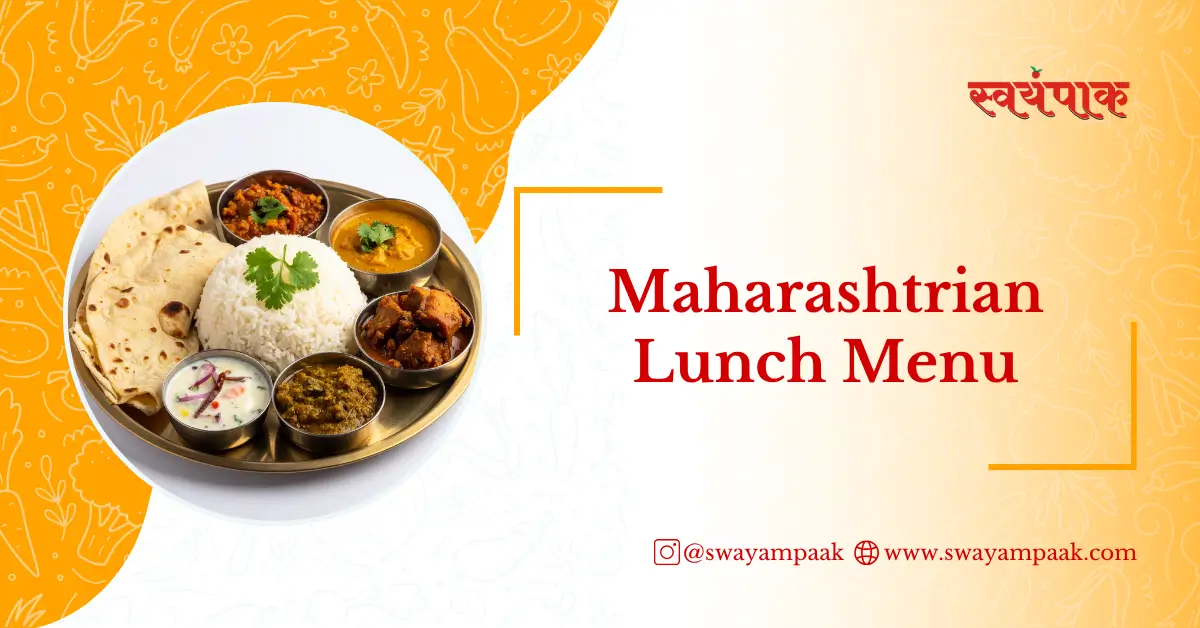
A traditional Maharashtrian lunch menu is a masterclass in balanced nutrition, blending “flavourful simplicity” through a combination of staples like rice or roti with protein-rich dals, seasonal vegetables, and digestive cooling drinks. Centered on the concept of a “balanced plate,” a typical meal includes varan‑bhat (toor dal and rice), a spicy usal or amti, and traditional accompaniments like koshimbir (salad) or thecha (spicy chutney). Whether you are exploring the fiery Tambda Rassa of Kolhapur or the comforting Pithla Bhakri of the Deccan plateau, Maharashtrian cuisine offers a diverse tapestry of 23+ iconic dishes that cater to every palate and dietary need.
- What Defines a Traditional Maharashtrian Lunch Menu?
- The 23 Iconic Maharashtrian Lunch Menu Dishes Every Foodie Should Know
- Main Course Staples
- Protein-Packed Curries: Usal and Amti
- Stuffed Specialities: The Bharli Series
- Savoury Snacks and Sides
- Festive Desserts
- Regional Deep-Dive: Maharashtra's 5 Major Cuisines
- The Secret to Authentic Flavour: Masalas and Souring Agents
- Mastering the Tang: Kokum, Tamarind, and Lemon
- Modern Healthy Swaps for 2026
- The Grain Revolution: Jowar, Bajra, and Ragi
- Seasonal Eating
- How to Assemble a Professional Maharashtrian Thali?
- Conclusion: A Heritage of Innovation
What Defines a Traditional Maharashtrian Lunch Menu?
The Anatomy of a Balanced Plate
A traditional Maharashtrian lunch is built around four pillars: carbohydrates, protein, fibre, and hydration. Each dish on the table fills one of these roles, and skipping any pillar leaves the meal feeling incomplete.
Carbohydrates come from bhakri (flatbread made from jowar, bajra, or ragi) or steamed rice. These grains are not interchangeable. Jowar Roti vs Wheat Roti explains why jowar bhakri offers slower energy release and better gut tolerance than refined-wheat alternatives. In Vidarbha, bajra bhakri dominates winter meals, while coastal families lean on rice.
Protein arrives through dal, usal (sprouted legume preparations), or amti (a thin, tangy lentil curry). The choice of legume matters. Toor Dal vs Masoor Dal is useful reading before deciding which pulse to anchor your curry.
Fibre comes from a dry vegetable preparation (sabzi) and a small salad or koshimbir. Seasonal greens such as ambadi (sorrel), methi, or shepu (dill) appear here, rotating with the harvest calendar.
Hydration closes the meal. This is where Maharashtrian food diverges from many other Indian cuisines.
The Role of Digestion: Sol Kadhi and Taak
Sol Kadhi is a coconut milk drink acidulated with kokum. It is served chilled at the end of a Malvani or Konkan meal. Kokum contains hydroxycitric acid and garcinol, compounds that have been studied for their role in reducing gastric acidity.
Taak (spiced buttermilk) serves the same function in the inland regions. Fermented dairy introduces beneficial bacteria to the gut, while the cumin and asafoetida in the tempering ease digestion further.
Both drinks follow centuries of intuition: end a heavy lunch with something cool, sour, and probiotic. Modern nutrition largely agrees.
The 23 Iconic Maharashtrian Lunch Menu Dishes Every Foodie Should Know
Main Course Staples
Varan-Bhaat
Varan is a simple toor dal tempered with ghee, cumin, and a hint of asafoetida. It is ladled over plain steamed rice. The combination is the Maharashtrian equivalent of comfort food and serves as the base of every homestyle lunch.
The dal used matters. Chana Dal vs Toor Dal breaks down texture, cooking time, and flavour differences if you want to experiment with the base legume.
Masale Bhaat
Masale Bhaat is a spiced rice dish cooked with vegetables, fresh coconut, and Goda Masala. The defining ingredient is green raw mango added during the rainy season for its sharp tang. It is simultaneously a side dish and a centrepiece.
Pithla Bhakri
Pithla is a thick besan (chickpea flour) gravy, tempered with mustard seeds, green chillies, and curry leaves. It is served with thick jowar or bajra bhakri and is perhaps the most rural, most honest dish in the Maharashtrian canon. No restaurant version quite matches what comes out of a village hearth.
Thalipeeth
Thalipeeth is a multigrain flatbread made from a blend of roasted flours called bhajaniche peeth. Each family has its own ratio of jowar, bajra, wheat, rice, and legume flours. The flatbread is cooked on a cast-iron tawa with a generous drizzle of oil and served with white butter or yoghurt.
You may recognise Thalipeeth from the Maharashtrian Breakfast Dishes guide, where it also appears as a hearty morning option.
Protein-Packed Curries: Usal and Amti
Matki Usal
Matki (moth beans) are soaked overnight and allowed to sprout for 24 hours. The sprouted beans are then cooked in a dry or semi-dry preparation with onion, coconut, and a restrained spice blend. Sprouting activates enzymes that increase the bioavailability of zinc and iron, making Matki Usal one of the most nutritionally dense items on the Maharashtrian table.
For a broader view of plant-based proteins in Indian cooking, the guide on High Protein Vegetarian Foods is worth reading alongside this.
Misal Pav
Misal Pav begins as a spiced matki or mixed sprout curry (the “misal”). It is topped with a crunchy farsan mixture, raw onion, lemon, and a fiery red tarri (thin spiced gravy). Pav bread accompanies. It started as breakfast in Pune and Nashik, but has earned a permanent place as a lunch dish across the state.
Chavli Amti
Black-eyed peas (chavli) which are cooked in a slightly tangy, mildly spiced gravy. Tamarind or kokum provides the sour note. The texture is soft and hearty, making this one of the most filling protein options on a Maharashtrian plate.
Curious about the difference between black and white varieties? Black Chana vs White Chana covers how legume colour affects taste, texture, and nutrition.
Traditional Aamti
Aamti is a thin, soupy toor dal preparation distinguished by Goda Masala and kokum. Unlike the heavier North Indian dal preparations, aamti is almost brothy. It is served in small quantities alongside rice, meant to be sipped or mixed lightly, not drowned in.
Stuffed Specialities: The Bharli Series
Bharli Vangi (Stuffed Brinjal)
Small baby brinjals are slit, filled with a peanut-coconut-spice mixture, and slow-cooked in their own steam. The result is a dish where the shell and filling meld into one. The choice of brinjal matters significantly here. Different Types of Eggplants explains which variety holds up best to stuffing and braising.
Bharli Bhindi (Stuffed Okra)
Bhindi (okra) pods are slit lengthwise and stuffed with a dry spice paste of peanuts, sesame, dry coconut, and red chilli. The stuffed pods are pan-fried until just tender. It is one of the few Maharashtrian dishes where the vegetable itself carries all the seasoning without a separate gravy.
Savoury Snacks and Sides
Kothimbir Vadi
A steamed, then shallow-fried or baked square made from besan, fresh coriander, and sesame seeds. Kothimbir Vadi is crisp on the outside, tender inside. It appears as a side at lunch and as a teatime snack with equal frequency.
Aluchi Vadi
Colocasia (arbi/taro) leaves are spread with a spiced besan paste, rolled tightly, steamed, and then sliced into rounds. The rounds are tempered with sesame and dry coconut. It is one of the more laborious preparations in the Maharashtrian repertoire and usually reserved for Sunday lunches or festive spreads.
Vada Pav
A spiced mashed potato fritter (batata vada) encased in chickpea batter, deep-fried, and served in a soft pav bun with dry garlic chutney and green chutney. It originated in Mumbai in the 1960s as a fast, affordable working-class meal and is now recognised globally as Maharashtra’s signature street food.
Festive Desserts
Puran Poli
A flatbread stuffed with a cooked filling of chana dal (split Bengal gram), jaggery, cardamom, and nutmeg. The stuffing is called puran; the outer wheat dough is the poli. It is the centrepiece of Holi and Gudhi Padwa celebrations and marks the beginning of the new year in many Maharashtrian households.
The sweetener choice between jaggery and sugar changes the flavour profile noticeably. Sugar vs Jaggery explores why most traditional recipes insist on jaggery.
Modak
A steamed rice flour dumpling filled with coconut and jaggery, shaped into a pleated dome. Modak is prepared for Ganesh Chaturthi and is considered Ganpati Bappa’s favourite offering. The fried version (talniche modak) is also popular and has a crispier shell.
Shrikhand
Hung curd (strained yoghurt) sweetened with sugar and flavoured with saffron, cardamom, and pistachios. It is thick, cool, and intensely flavoured. Shrikhand is the dessert most commonly served at a full Maharashtrian thali. A mango variant called Amrakhand, made with Alphonso puree, is specific to the summer season.
Regional Deep-Dive: Maharashtra’s 5 Major Cuisines
Malvani (Konkan Coast)
The Konkan strip running from Ratnagiri to Sindhudurg is defined by three things: fresh coconut, kokum, and seafood. Almost every Malvani curry begins with a paste of fresh coconut and a blend of dried red Malvani chillies that are moderately hot but deeply fragrant.
Kokum is the souring agent of choice here. Unlike tamarind, which can be earthy and heavy, kokum delivers a clean, fruity tartness that brightens fish and seafood without overpowering delicate flavours. Sol Kadhi is the most famous application.
A lunch in a Malvani home typically includes fish curry, rice, sol kadhi, and a coastal dry vegetable such as kelphul bhaji (jackfruit flower).
Kolhapuri (Southwest)
Kolhapuri food is the fiercest in Maharashtra. Kolhapuri Masala, a blend of over twenty dried spices including stone flower (dagad phool) and black stone flower, is ground and used as the base for the city’s two most famous dishes: Tambda Rassa (red mutton broth) and Pandhra Rassa (white coconut broth). Both are served alongside a main meat or vegetable preparation.
The heat here is not just about chilli quantity. The spice blend creates layered warmth that builds slowly, which is why Kolhapuri food is considered harder to replicate than it looks.
Varhadi and Nagpuri (Vidarbha Region)
Vidarbha cuisine is earthy, pulse-forward, and heavily influenced by the region’s cotton and orange-farming culture. Varhadi cooking uses dried coconut, peanuts, and sesame in larger proportions than the Konkan.
The standout regional style is Saoji, from Nagpur. Saoji dishes are built on a powerful masala blend that releases oils on cooking, creating the signature “tarri” (floating red oil layer on top of the curry). This tarri is not a flaw. It is proof that the spice blend has been cooked correctly.
The Nagpuri Saoji Masala from Swayampaak is made using traditional proportions of these dried whole spices, making it a reliable shortcut to an authentic Vidarbha flavour at home.
Khandeshi (Northwest: Dhule and Jalgaon)
Khandesh sits at the meeting point of Maharashtra, Madhya Pradesh, and Gujarat. Its cuisine borrows from all three but has a distinct character: Kala Masala (a dark, smoky spice blend), shev (thin chickpea flour noodles), and a love of robust, slow-cooked preparations.
Shev Bhaji is the region’s most iconic dish: a thin tomato-onion gravy finished with the Khandeshi Kala Masala and topped with crispy shev at the point of serving. The woody, smoky notes in the masala come from a high proportion of dried red chillies and coriander seeds roasted until very dark.
Deshastha (Deccan Plateau: Pune and Nashik)
Deshastha Brahmin cooking is the template for what most people picture when they think of Maharashtrian home food. It is mild, fragrant, ghee-laden, and built around Goda Masala, a sweet-aromatic blend that contains stone flower, bay leaves, cinnamon, and cardamom alongside the standard chilli-coriander-cumin base.
A Deshastha lunch leans on aamti, varan, rice, bhakri, a dry sabzi, koshimbir, and a small serving of pickle. Everything on the plate is cooked with restraint. The philosophy is to let the main ingredient shine, not the spice.
The Secret to Authentic Flavour: Masalas and Souring Agents
The Masala Trio
Three masalas define the three dominant flavour profiles of Maharashtrian cooking. Understanding them helps you identify which regional dish you are eating and which one to use when cooking.
Goda Masala (sweet and aromatic): Used in Deshastha and Pune-style cooking. The stone flower and coconut in the blend give it a slightly sweet, almost perfumed quality. Best used in aamti, masale bhaat, and vegetables cooked with coconut.
Kolhapuri Masala (hot and robust): Contains a higher proportion of dried red Kolhapuri chillies and stone flower. Produces deep red curries with layered heat. Designed for meat and bold vegetable preparations.
Kala (Saoji) Masala (dark, smoky, and intense): Used in Nagpuri Saoji cooking. The spices are roasted darker than in any other Indian masala blend, producing an almost coffee-like depth. The Nagpuri Saoji Masala captures this roasting profile precisely and can be used for both vegetarian and non-vegetarian Vidarbha-style curries.
Mastering the Tang: Kokum, Tamarind, and Lemon
Souring agents are not interchangeable. Each brings a different quality of acidity.
Kokum: Fruity, light, and clean. Use in Malvani curries, sol kadhi, and any dish where you want brightness without heaviness. Pairs well with coconut milk.
Tamarind: Earthy, deep, and complex. Use in Kolhapuri and Khandeshi preparations, or wherever a curry needs body alongside sourness. Also essential in the chutneys that accompany Vada Pav and Misal.
Lemon: Sharp, instant, and fresh. Used as a finishing agent, never cooked in. A squeeze over Misal Pav or Thalipeeth brightens everything it touches without changing the underlying flavour. The Lemon vs Lime guide explains why lime works differently, even when the two look similar.
For dishes where the pickle provides the sour note, the Pickle Pairing Guide is a practical resource for matching the right achar to the right curry.
Modern Healthy Swaps for 2026
Cooking Techniques
Many traditional Maharashtrian snacks are deep-fried: Vada Pav, Kothimbir Vadi, and Aluchi Vadi. Each has a healthier cooking path that preserves flavour.
Kothimbir Vadi is traditionally steamed before frying. Stopping at the steaming stage removes most of the oil while keeping the interior texture intact. For those who want some crispness, a light brush of oil and ten minutes in an oven at 200 degrees Celsius achieves a similar result.
Batata Vada (the filling in Vada Pav) can be baked rather than batter-fried. The result is slightly drier but dramatically lighter. Pairing baked vadas with a quality Green Chilli Pickle compensates with the kind of sharpness that frying used to provide.
The Grain Revolution: Jowar, Bajra, and Ragi
Maharashtra has always been a multi-grain culture. The shift in recent years is a return to ancient grains that were sidelined during the wheat boom of the 1970s.
Jowar (sorghum) bhakri has a lower glycaemic index than wheat roti and is naturally gluten-free. Jowar Roti vs Wheat Roti contains a full nutritional comparison.
Bajra (pearl millet) bhakri is iron-rich and particularly suited to winter. Bajra Roti vs Wheat Roti explains why Vidarbha farmers prized it for cold-weather energy.
Ragi (finger millet) is the highest-calcium grain in the Maharashtrian pantry. Ragi Roti vs Wheat Roti makes the case for adding it to a lunch rotation. The Different Types of Atta in India article covers all three grains alongside a wider discussion of Indian flour varieties.
Seasonal Eating
The Maharashtrian kitchen has always been calendar-conscious. Eating seasonally is not a modern trend here; it is how the cuisine was designed.
Summer (March to June): Raw mango season. Kairi Panha (raw mango drink with jaggery) is the lunchtime coolant. Aam Panha, Methamba (sweet mango pickle), and raw mango in masale bhaat all appear in this window.
Monsoon (June to September): Green bhaji season. Leafy vegetables like ambadi, methi, and shepu flood the markets. Usal preparations shift to fresh green legumes. Kothimbir Vadi is also particularly good in the rains when fresh coriander is at its most pungent.
Winter (October to February): Bajra bhakri and heavy pulses dominate. Til (sesame) preparations increase as the body seeks warmth. This is also the season for fresh green garlic, which appears in several Maharashtra-specific pickles, including the Amla and Chilli Pickle.
How to Assemble a Professional Maharashtrian Thali?
Plating Sequence
A traditional Maharashtrian thali follows a deliberate left-to-right sequencing on the plate. Understanding this sequence helps both in serving and in eating the meal in the right order.
- Start with staples: Bhakri or rice is placed at the centre. On the right side, small portions of aamti and varan are positioned for easy mixing.
- Add protein curries: Usal or amti goes in a small bowl at the top of the thali. These are the richest preparations and are consumed in controlled portions.
- Place dry vegetables: Sabzi sits to the left. It provides textural contrast to the liquid components and is eaten alongside bhakri rather than rice.
- End with cooling elements: Koshimbir (fresh salad) and a small serving of shrikhand or yoghurt close the thali. They signal the digestive wind-down.
For a wider perspective on how different regional thalis are structured across India, Different Types of Thali in India provides a useful comparison.
The Flavour Punch: Texture and Heat
Two components complete every Maharashtrian thali: papad and pickle.
Papad provides crunch, which is otherwise missing from a plate built around soft, moist preparations. It also absorbs trace flavours from the aamti and koshimbir it sits alongside.
Pickle is where personal preference intersects with regional identity. Mango pickle (raw or sweet), lemon pickle, green chilli pickle, and mixed pickles all exist on the Maharashtrian table. The Types of Pickles in Maharashtra is an in-depth guide to regional achar traditions. For those who want a quick primer on fermented versus oil-based preparations, Fermented Pickles vs Oil-Based Pickles covers the key differences.
Swayampaak’s Homemade Pickles Collection includes traditional Maharashtrian options made without synthetic preservatives, including the sweet and sour Methamba and the sharp Masala Mango Pickle. The Benefits of Indian Pickles article explains why these fermented accompaniments add more than just flavour to a meal.
Conclusion: A Heritage of Innovation
The Maharashtrian lunch menu has never been static. It absorbed rice cultivation from the Konkan coast, peanuts and chillies from colonial trade routes, and sprouting techniques from centuries of Jain and Brahmin dietary traditions.
What makes it resilient is its underlying logic. Balance the macronutrients. Use whole grains. Season with regional masalas that are built on medicinal knowledge. End with a digestive drink. That logic holds equally well in a village kitchen in Vidarbha and in a modern apartment in Pune.
For 2026, the practical move is to swap one wheat-based item per week with jowar or bajra, steam one preparation that you would normally fry, and try cooking with a proper regional masala rather than a generic blend.
To start, explore the authentic Nagpuri Saoji Masala to bring Vidarbha’s signature smoky depth to your kitchen, or browse the Homemade Pickles Collection for traditional Maharashtrian accompaniments made without preservatives. Both are made the way they have always been made, which is exactly the point.